William J. Smart
(1893 – 1962)William J. Smart
William J. Smart began his career as a teenage “paint boy” before becoming a scenic artist at Sosman & Landis in Chicago, where he worked from approximately 1908 to 1921. During those formative years, he developed the perspective and drafting skills that would define his later career. According to Wendy Waszut-Barrett’s research on Sosman & Landis, Smart was among a generation of scenic artists trained in one of America’s most influential theatrical paint studios before moving into motion pictures.
William J. Smart and Hollywood Scenic Art
In the 1920s, William J. Smart joined four former Sosman & Landis employees in establishing Service Studios in Chicago. He later moved to Detroit, where he worked on Norman Bel Geddes’s Futurama for General Motors’ Highways and Horizons exhibition at the 1939–40 New York World’s Fair. Shortly afterward, he relocated to Los Angeles and became an important member of George Gibson’s scenic art department at MGM. Karen Maness notes that Gibson relied on Smart’s expertise in perspective, an essential skill in creating the large-scale painted backdrops used throughout Hollywood’s Golden Age.
In the early 1950s, Smart left MGM to join John H. Coakley at 20th Century Fox, where he remained until the end of his career. Karen Maness credits him with scenic art on The Wizard of Oz (1939), The Snows of Kilimanjaro (1952), The Robe (1953), and Cleopatra (1963). IMDb additionally records William J. Smart as an uncredited scenic artist on productions associated with MGM and 20th Century Fox, helping document work that often went uncredited in studio-era filmmaking.
Legacy
William J. Smart’s career reflects the movement of highly trained theatrical scenic artists into Hollywood during the twentieth century. His work connected the traditions of Sosman & Landis, the innovation of the 1939–40 World’s Fair, and the collaborative scenic art departments of MGM and 20th Century Fox. Through his mastery of perspective painting, Smart contributed to some of the best-known films of the studio era while helping shape the visual realism that defined Hollywood scenic art.
Richard M., Maness, Karen L. 2016. The Art of the Hollywood Backdrop, ReganArts., Waszut-Barrett, Wendy. 2021. Sosman & Landis: Shaping the Landscape of American Theatre. Employee No. 46 – William Smart, Oct 30.
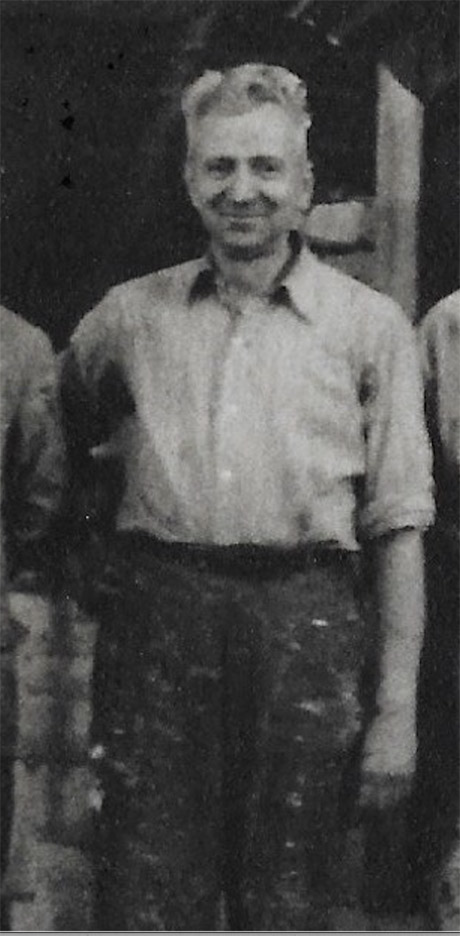
William Joseph Smart at MGM 1946
Jean Gibson Collection