F. Wayne Hill
(1906 – 1975)F. Wayne Hill at MGM
F. Wayne Hill (1906–1975) belonged to the generation of scenic artists who established MGM’s reputation for painted backdrops during Hollywood’s Golden Age. Working under Scenic Art Supervisor George Gibson, Hill became one of the department’s principal colorists, determining the color relationships that established the overall appearance of each backdrop before painting began. He also led the drawing and layout of scenic compositions, translating a production’s visual requirements into full-scale designs for the scenic art crew.
Color, Composition, and Collaboration
Like most Hollywood scenic artists, F. Wayne Hill worked as part of a collaborative department in which artists specialized in different stages of production. As a colorist, he established the palette and atmosphere that guided the finished backdrop, while his work in layout ensured that perspective and composition aligned with the camera’s point of view. His contribution was both artistic and technical, requiring a command of painting, architecture, and visual illusion.
Hill received screen credit as the colorist for Forbidden Planet (1956), one of MGM’s most visually ambitious productions. The film’s painted landscapes depended on carefully controlled color and atmospheric effects that helped create an unfamiliar world while maintaining photographic realism.
Film Credits
Karen Maness documents F. Wayne Hill’s work on The Wizard of Oz (1939), Oklahoma! (1955), Forbidden Planet (1956), The Shoes of the Fisherman (1968), and Hello, Dolly! (1969). Research on MGM’s scenic art department also credits Hill with much of the architectural drawing for the recreation of the Sistine Chapel in The Shoes of the Fisherman, work that demonstrates the precision expected of Hollywood’s scenic artists on large-scale productions.
F. Wayne Hill’s Legacy
F. Wayne Hill spent his career creating environments that audiences accepted as real while rarely noticing the artists behind them. His work reflects the collaborative practice that defined Hollywood scenic art, where painters, designers, and colorists combined specialized skills to transform sound stages into convincing worlds. Through the Hollywood Backdrop Collection, Hill’s contributions remain part of the history of studio craftsmanship and the artists whose work shaped the visual language of American film.
Coakley, Gary (scenic artist). 2013. Interview with Karen L. Maness for the Art Directors Guild Oral History Project, June.
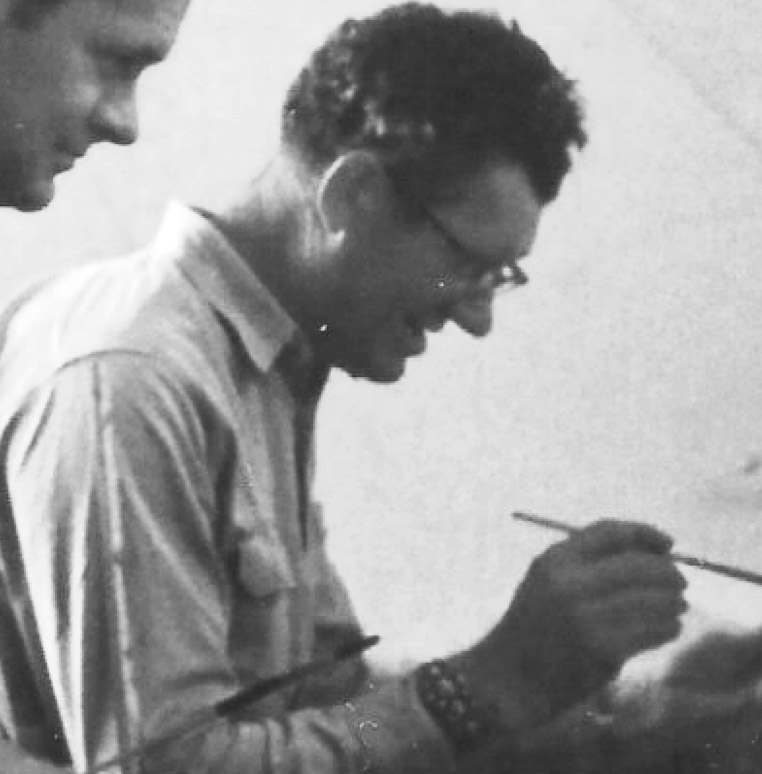
F. Wayne Hill, Hollywood scenic artist at MGM
Jean Gibson-Gorrindo Estate