Jaroslav Gebr
(1926-2013)Jaroslav “Jerry” Gebr
Born in a small village west of Prague, Jaroslav “Jerry” Gebr (1926–2013) combined classical European art training with more than five decades of work in the American motion picture industry. He studied at the Academy of Art in Prague from 1941 to 1943, where he became classmates with Emil Kosa Jr., who later served as art director at Twentieth Century-Fox. After escaping communist-occupied Czechoslovakia in 1949, Gebr continued his studies in Munich and Florence before painting portraits and frescoes in Bogotá, Colombia. He later immigrated to the United States, where an unexpected reunion with Kosa helped launch his Hollywood career.
Early Hollywood Career
Gebr’s first Hollywood project was Ada (1961), starring Dean Martin. He soon completed a mural for Bob Hope’s A Global Affair (1964) and contributed featured murals, paintings, and diagrams to Fantastic Voyage (1966). His academic training and exceptional skill as a portrait painter quickly distinguished him within Hollywood’s scenic art departments.
MGM Scenic Art Supervisor George Gibson later invited Gebr to paint the principal portraits for the studio’s full-scale recreation of Michelangelo’s Sistine Chapel in The Shoes of the Fisherman (1968). The commission demonstrated Gebr’s ability to adapt traditional European portrait painting to the demands of large-scale scenic art for motion pictures.
Universal Studios and Portrait Painting
Gebr later became head of the Scenic Art Department at Universal Studios, a position he held for approximately three decades. A member of the Art Directors Guild beginning in 1972, he worked with filmmakers including Alfred Hitchcock, Steven Spielberg, Clint Eastwood, and Vincente Minnelli while continuing to specialize in portrait painting.
His work included the opening credit artwork and chapter illustrations for The Sting (1973), key paintings for Rod Serling’s Night Gallery (1969–1973), and dozens of portraits created for feature films and private commissions. Among his portrait subjects were Barbara Streisand, Orson Welles, Lou Wasserman, Lucille Ball, and Alfred Hitchcock.
IMDb also documents Gebr’s work on productions including The Hindenburg (1975), The Towering Inferno (1974), Comes a Horseman (1978), Xanadu (1980), The Blues Brothers (1980), The Incredible Shrinking Woman (1981), Cat People (1982), Apollo 13 (1995), and The Country Bears (2002). His television credits include The Wild Wild West, Night Gallery, The Sixth Sense, Columbo, Amazing Stories, Murder, She Wrote, Coach, Battlestar Galactica, My Name Is Earl, and 24: Redemption. Together, these credits document the remarkable range of his work across film and television.
Public Commissions
In 1977, Gebr presented three paintings to President Gerald Ford for the Oval Office, commemorating the 200th anniversary of the United States Army. His artwork is also displayed at the Consulate General of the Czech Republic in Los Angeles. These commissions demonstrate that his work extended well beyond the motion picture industry into public and diplomatic settings.
Legacy
In 2017, the Art Directors Guild’s Gallery 800 honored Jaroslav Gebr with the exhibition A Tribute to Jaroslav Gebr, which you can read about here, celebrated a career that bridged European academic painting and Hollywood scenic art. Through portraits, murals, visual effects, title artwork, and scenic painting, Gebr brought classical artistic traditions into the collaborative world of motion picture production. His work remains an enduring part of Hollywood scenic art history.
Gebr, Tomas 2019. Telephone Interview with Karen Maness, October., Isackes, Richard M., Maness, Karen L. 2016. The Art of the Hollywood Backdrop, ReganArts
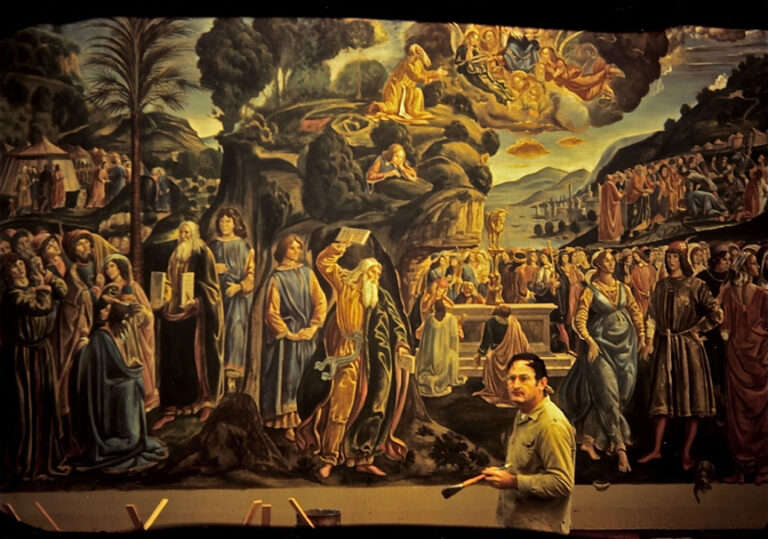
Jaroslav "Jerry" Gebr painting key portraits for MGM's The Shoes of a Fisherman (1969)
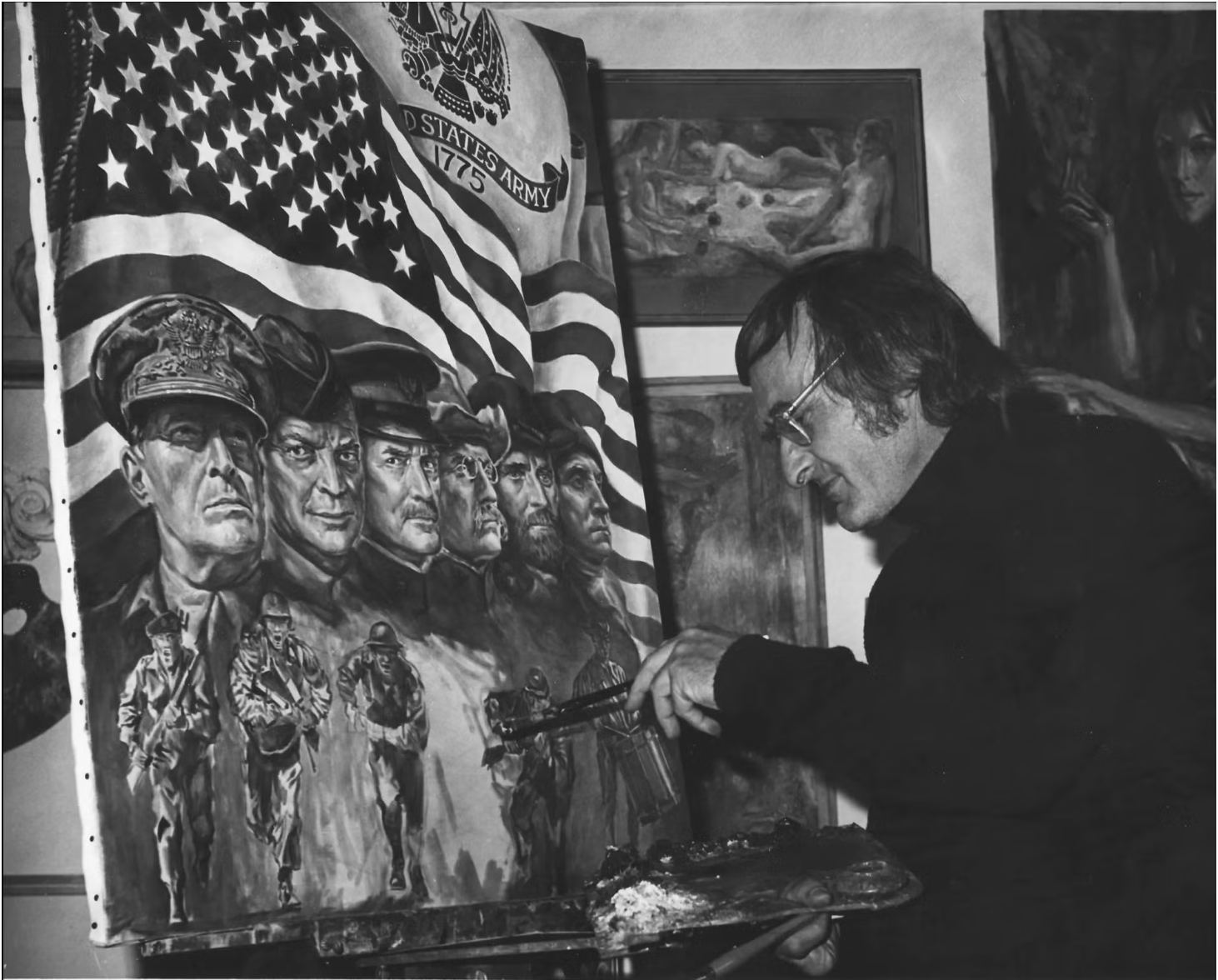
Jaroslav Gebr painting a portrait for President Gerald Ford's Oval Office in 1977, commemorating the U.S. Army's 200th anniversary
Courtesy Gebr Family Collection